


This podcast synthesizes the core arguments and evidence from Jacob Savage’s article, “The Lost Generation,” which posits that Diversity, Equity, and Inclusion (DEI) initiatives, institutionalized around the pivotal year of 2014, systematically disadvantaged an entire cohort of white male millennials across high-status professional fields. The analysis reveals a profound generational schism: while established Boomer and Gen-X white men largely retained their positions of power—often implementing DEI policies—their millennial counterparts faced a landscape of explicit and implicit exclusion at the entry and mid-levels of their careers.
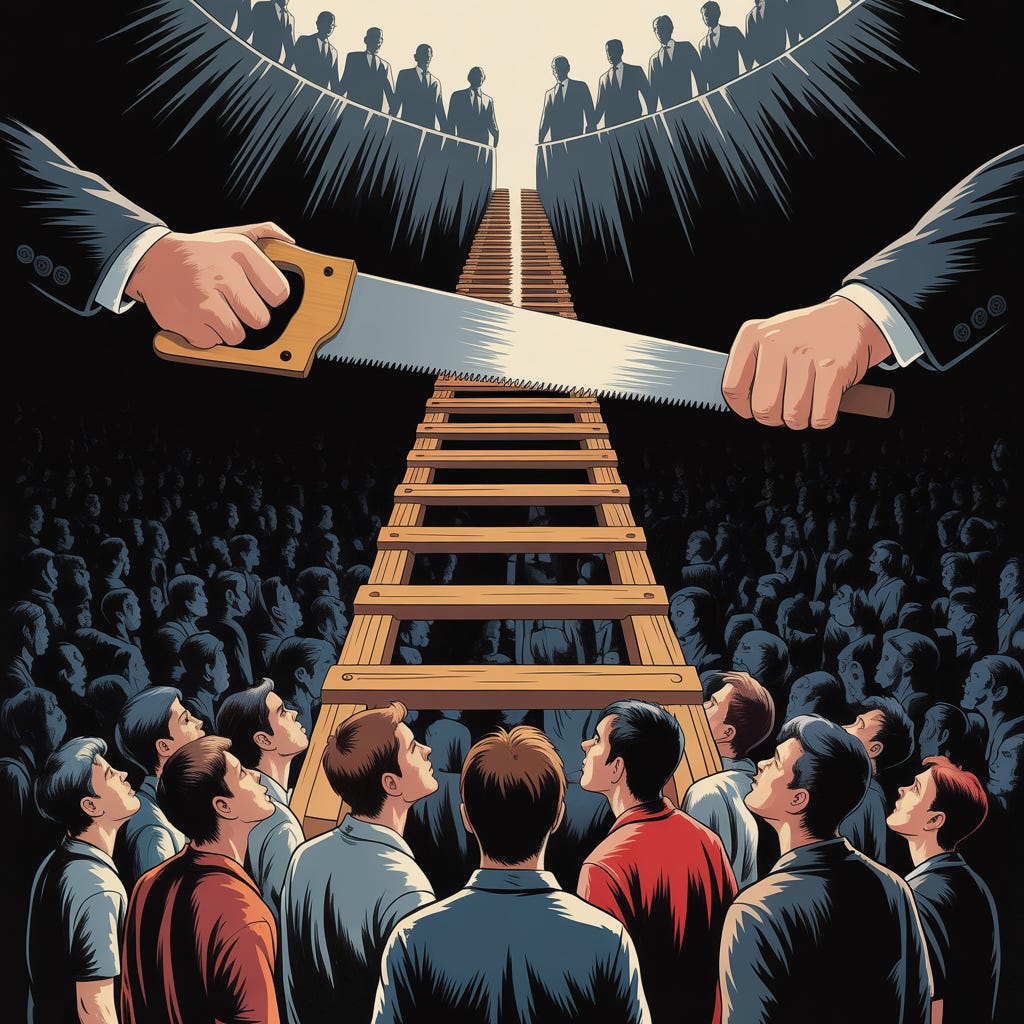
Drawing on statistical data and personal testimonies from individuals in media, academia, Hollywood, law, medicine, and tech, the article argues that this was not a “gentle rebalancing” but a significant redistribution of opportunity that blocked career paths, caused significant personal and financial distress, and engendered a deep skepticism toward the liberal project among those affected. The document concludes by raising critical questions about whether the institutions that championed these exclusionary practices have become stronger or have instead accelerated their own decline by abandoning meritocratic principles.
The Generational Schism: DEI’s Impact by Cohort
The central argument is that the professional impact of DEI was not felt uniformly among white men. A sharp distinction is drawn between generational cohorts, with 2014 identified as the “hinge” year.
• Established Boomers and Gen-X: White men who were already established in their careers by 2014 (e.g., aged 40) were largely insulated from the negative effects of DEI mandates. They held positions of power, and in many cases, were the ones who implemented the new diversity-focused hiring practices. The article notes, “Because the mandates to diversify didn’t fall on older white men, who in many cases still wield enormous power: They landed on us.”
• Emerging Millennials: In contrast, white men who were just beginning or attempting to advance their careers around 2014 (e.g., aged 30) “hit the wall.” They became the primary demographic group displaced to meet institutional diversity targets. For this cohort, DEI was experienced as a “profound shift in how power and prestige were distributed.”
A former management consultant articulated the sentiment felt by this group: “The world is not rooting for you—in fact, it’s deliberately rooting against you.”
Industry Analysis: A Systematic Re-Weighting of Opportunity
The article provides extensive evidence of a systematic shift away from hiring and promoting white male millennials across multiple professional sectors, which intensified after events like the 2014 #OscarsSoWhite controversy and the 2020 death of George Floyd.
Media and Journalism
The media industry underwent a rapid demographic transformation. While criticisms in the mid-2010s focused on newsrooms being “overwhelmingly made up of white men,” the subsequent correction was swift and dramatic, primarily affecting younger men.
Key Trends and Data:
• Hiring Bias: A senior hiring editor recalled the explicit nature of the new mandates: “For a typical job we’d get a couple hundred applications, probably at least 80 from white guys... It was a given that we weren’t gonna hire the best person… It was jarring how we would talk about excluding white guys.” White men, while nearly half the applicants, were filling closer to 10% of positions.
• Entry-Level Pipeline Collapse: Internships and fellowships, critical entry points, were reoriented.
◦ Los Angeles Times: Since 2020, only 7.7% of interns have been white men.
◦ The New York Times Fellowship: Since its 2018 inception, only 10% of nearly 220 fellows have been white men.
• Impact on Content: The demographic shift altered not just who told stories, but which stories were told. One journalist, “Lucas,” recounted with regret being assigned a piece on why calling the police is an act of white supremacy.
Academia
In the Ivory Tower, the push for diversity was compounded by the slow turnover of tenured Boomer faculty, concentrating the pressure for demographic change onto new, tenure-track hires.
Mechanisms of Exclusion:
• DEI Statements: Used by institutions like the University of California system as a “first cut” to eliminate candidates before faculty review, effectively screening out those who do not fit a desired identity profile.
• Cluster Hiring: Originally for interdisciplinary research, this method was repurposed to hire entire groups of “underrepresented candidates” at once, often by creating positions in fields strongly correlated with specific gender or ethnic identities (e.g., Latinx studies, transgender studies).
• Invisible Curriculum: A set of political assumptions shaped what research was considered viable. A graduate student recalled being told his interest in Roman military history was “white and European and male and dead,” marking him as “hopeless” on the job market.
Hiring Data (Tenure-Track Positions):
• Harvard (Humanities): White male representation fell from 39% of tenure-track positions in 2014 to 21% in 2024.
• Yale (Humanities): Since 2018, only 6 of 76 tenure-track hires (7.9%) have been white American men. The department retains 10 white male professors over the age of 70.
• Brown (Humanities & Social Sciences): Since 2022, only 3 of 45 tenure-track hires (6.7%) have been white American men.
• UC System:
◦ UC Irvine (Humanities & Social Sciences): Since 2020, just 3 of 64 hires (4.7%) are white men.
◦ UC Santa Cruz (Arts, Humanities & Social Science): Between 2020-2024, only 2 of 59 hires (3%) were white men.
• Foreign National Exception: Data suggests foreign white men on temporary visas are nearly twice as likely to secure tenure-track positions as white U.S. citizens, partly because they are not categorized as “white” in federal diversity metrics.
Hollywood and Entertainment
The entertainment industry, particularly television writing, saw some of the most explicit and documented forms of exclusion.
Key Evidence:
• Internal Agency Mandates: A 2017 internal “needs sheet” from a major talent agency revealed systematic discrimination. Staffing requests for TV writers’ rooms from top showrunners repeatedly used shorthand like “diverse,” “female,” and “women and diverse only.”
• Pipeline Programs: Prestigious fellowships and labs that once launched the careers of figures like Quentin Tarantino were fundamentally reoriented.
◦ Disney Writing Program: Over the past decade, none of the 107 writing fellowships or 17 directing fellowships were awarded to white men.
◦ Sundance Screenwriters Lab: Since 2018, only 8 of 138 fellows (5.8%) have been white men, nearly all of whom had an additional “defining characteristic” (e.g., gay, disabled) or were partnered with a woman or person of color.
• Statistical Decline:
◦ TV Writers (Lower-Level): White men fell from 48% of the pool in 2011 to just 11.9% by 2024.
◦ TV Directors: White men directed 69% of episodes in 2014, but only 34% by 2021, with the remaining share going mostly to established names.
◦ Oscar Nominations (Screenwriting): From 2014-2023, over fifty Gen-X white men were nominated, compared to just six white male millennials.
The Broader Professional Landscape
The trend was not confined to the cultural industries. Data shows a significant decline in white male representation in other high-status fields.
This exclusion led many to seek refuge in nascent, non-institutional fields like cryptocurrency, podcasting, and Substack, which lacked the DEI gatekeepers of established industries.
Personal and Societal Consequences
The article chronicles the profound personal and psychological toll on the men who navigated this professional environment.
• Career Stagnation and Financial Precarity: Individuals like “Andrew,” “Ethan,” and “Matt” spent years stuck in the same roles, unable to advance, accumulating debt, and postponing major life decisions like marriage and children. Ethan, a finalist for five tenure-track positions, stated, “It feels like a dead end.”
• Psychological Impact: The constant rejection and systemic disadvantage led to feelings of anger, bitterness, and a warped sense of self-identity. As Ethan noted, being a white man “moved into the foreground in a way that I didn’t expect.” Matt, the screenwriter, expressed a need for “self-preservation” to avoid becoming bitter, stating, “Nobody wants the guy shaking his fist.”
• Erosion of Trust in Meritocracy: A common theme is a feeling of betrayal. Many of the men interviewed started as liberals who believed in a “race and gender-blind meritocracy.” Witnessing its dismantlement engendered deep skepticism. The author concludes, “to see that vision so spectacularly betrayed has engendered a skepticism toward the entire liberal project that won’t soon disappear.”
• Institutional Decline: The article raises the question of whether these institutions have become stronger or more trusted as a result of these policies. It suggests that by “abandoning meritocracy,” media, academia, and Hollywood may have “accelerate[d] their decline.”
The author’s final reflection encapsulates the experience of his cohort: “The truth is, I’m not some extraordinary talent who was passed over; I’m an ordinary talent—and in ordinary times that would have been enough.”


